

Choose Year
Choose Year
Choose Year
When Lab Diagnostic Precision Meets Uncompromising Traceability
Where patient outcomes depend on absolute workflow integrity, your margin for error is exactly zero. Up to 70% of all mistakes made in laboratory diagnostics occur during the pre-analytical phase, specifically during sample collection, transport, and preparation (The Clinical Biochemistry Reviews, 2012). Because this phase involves extensive manual human handling, it remains the most vulnerable bottleneck to patient data integrity. To bridge this gap, integrating RFID technology offers a proven way to overcome critical mistakes in patient identification. Applying tailored RFID solutions directly onto laboratory components, manufacturers can drive smart medical device automation that significantly minimizes the impact of human factors.
At ADLM 2026, SAG is showcasing how vertically integrated RFID customization resolves these exact vulnerabilities at the source, replacing manual tracking checkpoints with automated precision.
At ADLM 2026, SAG is showcasing how vertically integrated RFID customization resolves these exact vulnerabilities at the source, replacing manual tracking checkpoints with automated precision.


Zero-error Sample Tracking
Human mistakes during transport and mechanical sorting are a primary source of preventable errors. Implementing RFID along the specimen life cycle can optimize these workflows by tracking container IDs automatically at key checkpoints such as collection and accessioning, eliminating manual transcription, and enabling intelligent sample routing.
However, standard RFID labels easily fail on blood or fluid-filled tubes due to liquid detuning. This physical interference blinds readers and forces laboratory staff back to manual, error-prone barcode scanning. Overcoming this requires tailored material and precise antenna tuning that maintains a stable impedance match despite liquid proximity.
However, standard RFID labels easily fail on blood or fluid-filled tubes due to liquid detuning. This physical interference blinds readers and forces laboratory staff back to manual, error-prone barcode scanning. Overcoming this requires tailored material and precise antenna tuning that maintains a stable impedance match despite liquid proximity.


Secure Consumable Authentication
Modern diagnostic instruments rely on a constant flow of specialized consumables, such as reagent reservoirs or proprietary cartridges. To ensure testing reliability, the instrument control unit must accurately capture automated parameters, including expiration dates, lot numbers, and use counts. However, traditional barcodes require a clear line of sight, making them impossible to read once a cartridge is inserted inside the instrument. This limitation exposes operations to manual entry mistakes, expired runs, or counterfeit third-party media that can invalidate test results.
The key advantage of RFID lies in its ability to eliminate line-of-sight constraints, enabling seamless data collection and automated configuration directly inside a closed diagnostic instrument. To address restricted spaces, miniaturized transponders can be precisely matched to tight layouts, such as reservoir caps or cartridge slots. This automated control setting protects brand integrity, and ensures testing reliability and manufacturing quality.
The key advantage of RFID lies in its ability to eliminate line-of-sight constraints, enabling seamless data collection and automated configuration directly inside a closed diagnostic instrument. To address restricted spaces, miniaturized transponders can be precisely matched to tight layouts, such as reservoir caps or cartridge slots. This automated control setting protects brand integrity, and ensures testing reliability and manufacturing quality.

Continuous Cold Chain Management
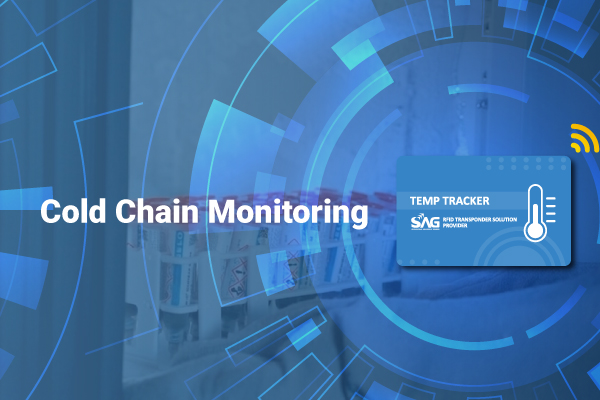
The quality and efficacy of temperature-sensitive reagents and biological specimens depend heavily on stable environmental conditions throughout storage and transport. Traditional data loggers track large shipping boxes, but they cannot verify if an individual specimen experienced a hidden thermal breach before reaching the testing tray. These undetected temperature variations remain completely invisible until a diagnostic test fails, leading to wasted materials and compromised results.
Here comes with the core advantage of sensor-integrated RFID, recording continuous temperature history directly on the individual label. This allows operators to track thermal data without manual inspections. By automatically writing real-time thermal deviations onto the tag's memory chip, this technology provides an uncompromised digital audit trail that ensures sample integrity.
Here comes with the core advantage of sensor-integrated RFID, recording continuous temperature history directly on the individual label. This allows operators to track thermal data without manual inspections. By automatically writing real-time thermal deviations onto the tag's memory chip, this technology provides an uncompromised digital audit trail that ensures sample integrity.
Let’s Talk at Booth #4107
Every laboratory workflow and medical instrument presents its own unique physical constraints. Successful RFID implementation is rarely about deploying a generic, off-the-shelf tag, it is about precisely tailoring the physics of the technology to fit your specific engineering architecture.
If you are currently designing a next-gen diagnostic device, experiencing workflow tracking blind spots, or looking to ruggedize your consumable authentication, let’s solve it together. Bring your trickiest challenges to SAG’s experts in Anaheim for a dedicated consultation. Meet Us at:
If you are currently designing a next-gen diagnostic device, experiencing workflow tracking blind spots, or looking to ruggedize your consumable authentication, let’s solve it together. Bring your trickiest challenges to SAG’s experts in Anaheim for a dedicated consultation. Meet Us at:
- Place: Anaheim Convention Center, CA, USA
- Date: 28–30 July, 2026
- Booth No.: 4107