Choose Insights
Choose Year
What is RFID Label?
RFID tags are the core building blocks of any RFID system. In everyday use, the term ‘RFID tags’ often refers to the entire family of RFID products, including hard tags, labels, cards, and keyfobs. Each of these formats serves the same purpose: enabling wireless data capture through a microchip and antenna, but they differ in design, durability, and use cases. Understanding these distinctions is key to choosing the right tag for your application .
Within this family, RFID labels are valued for being thin, flexible, and cost-effective, making them ideal for high-volume deployment. From retail and logistics to manufacturing and healthcare, labels enable businesses to efficiently integrate RFID into daily operations without adding complexity.
Within this family, RFID labels are valued for being thin, flexible, and cost-effective, making them ideal for high-volume deployment. From retail and logistics to manufacturing and healthcare, labels enable businesses to efficiently integrate RFID into daily operations without adding complexity.
1. What is RFID Label?
An RFID label is a thin, flexible form of RFID tag designed to be affixed directly to products or packaging. Embedded within the label are a microchip and an antenna that communicate wirelessly with an RFID reader.
Unlike RFID hard tags, RFID labels are lightweight, printable, and cost-effective for scalable applications. Their flexibility allows them to be applied to cartons, items, or containers while making them a practical choice for industries that require efficient item-level tracking.
With the ability to be encoded and printed on demand, RFID labels streamline data collection, enhance supply chains' visibility, and support automated workflows where speed and accuracy are essential.
Unlike RFID hard tags, RFID labels are lightweight, printable, and cost-effective for scalable applications. Their flexibility allows them to be applied to cartons, items, or containers while making them a practical choice for industries that require efficient item-level tracking.
With the ability to be encoded and printed on demand, RFID labels streamline data collection, enhance supply chains' visibility, and support automated workflows where speed and accuracy are essential.
2. Unwrapping RFID Labels: What’s Inside the label You See Every Day?
An RFID label comprises multiple layers, each serving a specific role to ensure performance, durability, and ease of use. Understanding these components helps you select the right label for your application. From store shelves to factory floors, RFID labels are redefining how businesses track, manage, and connect their assets.
Let’s look at how they’re built!
Let’s look at how they’re built!
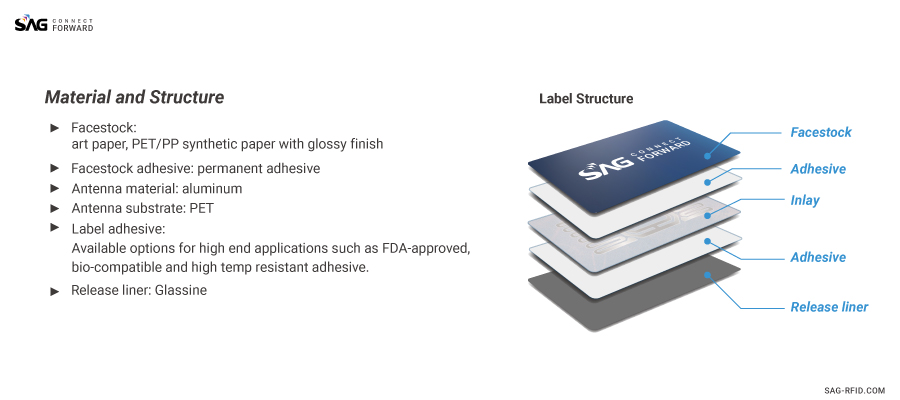
Key Components of an RFID Label
- Facestock
The top layer serves as the printable surface. It can be made from art paper or PET/PP synthetic paper with a glossy finish, supporting thermal transfer printing for information like UID or serial numbers.
Located beneath the facestock, this adhesive bonds the printable layer to the inlay. Most RFID labels use a permanent adhesive to ensure long-lasting structural integrity.
The inlay is the core of every RFID product. A thin assembly of a microchip and antenna mounted on a PET substrate. The antenna, typically made of high-quality aluminum, receives radio waves from readers, while the chip retains and transmits data. This inlay determines the label’s read range, frequency compatibility, and overall RF performance.
This adhesive layer allows the RFID label to be attached to its target surface. To support diverse environments and industries, SAG offers a range of adhesive options, including FDA-approved, biocompatible, low-temp resistan t, and pressure-sensitive hot melt adhesives. Ensuring suitable attachment in applications like healthcare, food logistics, and industrial asset management.
The glassine release liner protects the adhesive before use and allows smooth label dispensing during printing or automated labeling.
Together, these layers form a flexible yet high-performing RFID label that integrates seamlessly into supply chains, enabling reliable identification, scalable automation, and real-time visibility across everyday operations.
RFID Inlays v.s RFID Labels
| Feature | ||
|---|---|---|
| Composition | Chip + Antenna | Inlay + Facestock + Adhesive Backing + Liner |
| Protection | Fragile and easily damaged | Durable protection by the outer printable material |
| - ShieldX: SAG provides a protective glob-top coating to resist physical impact and environmental stress. | ||
| Use Cases | Needs to be converted into a label, tag, or card | Ready to be printed with information (barcodes, serial numbers) and direct application |
3. Why RFID Label Matters? (Benefits of RFID Labels)
RFID labels turn ordinary items into smart, trackable assets, giving every product a digital voice. More than just identifiers, RFID labels connect physical items to digital systems across every stage of the supply chain, enabling automation, visibility, and smarter decision-making .
Their thin and flexible form factor supports RFID adoption across lightweight items, consumer packaging, and high-volume logistics workflows. By embedding intelligence directly into product labels, businesses reduce material costs, accelerate operations, and enable item-level traceability.
From serial numbers to EPC standards, SAG’s custom encoding service ensures each RFID label aligns with your system’s data structure for printing. This enables seamless interoperability and plug-and-play deployment, so each label is ready to use right out of the box.
Their thin and flexible form factor supports RFID adoption across lightweight items, consumer packaging, and high-volume logistics workflows. By embedding intelligence directly into product labels, businesses reduce material costs, accelerate operations, and enable item-level traceability.
From serial numbers to EPC standards, SAG’s custom encoding service ensures each RFID label aligns with your system’s data structure for printing. This enables seamless interoperability and plug-and-play deployment, so each label is ready to use right out of the box.
The Benefits at a Glance
- Lightweight & Flexible: Thin construction optimized for label conversion and printing, suitable for common product and packaging surfaces.
- High-volume Ready: Easily integrated into printing and labeling workflows for fast, scalable item-level tagging.
- Seamless Integration: Compatible with existing barcode or logistics systems through tailored encoding, ensuring plug-and-play deployment.
- Cost-efficient Intelligence: Enables scalable, item-level traceability through efficient label materials and high-volume production.
4. Applications of RFID Labels
RFID labels are widely applied across industries to enable item-level identification and tracking in real-world operations. Their flexible form factor allows them to be utilized on a range of tagging surfaces — from consumable packaging to metal devices. Across retail , manufacturing, logistics, and healthcare, RFID labels help streamline operations by delivering item-level visibility and real-time data.

- Asset & Equipment Tracking
RFID labels can be applied directly on metal containers, maintenance tools, or machine components to monitor location and usage. Even in dense-metal environments such as storage racks or tool cabinets, SAG’s antenna and material design ensure stable read performance and reliable tracking.
- Inventory Management
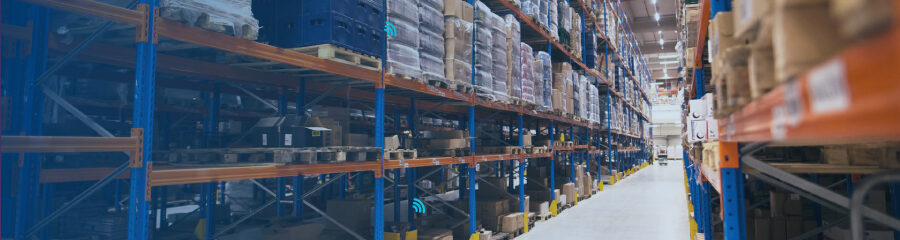
From warehouses to retail shelves, RFID labels streamline inventory management with fast scanning, automated stock updates, and real-time visibility. In challenging scenarios such as refrigerated goods, sterilizable inventory, or liquid-filled medications, we provide RFID labels that deliver reliable performance in these applications.
🔗 LiquidMate O for Injectable vials

- Logistics Tracking
In logistics and distribution workflows, RFID labels support real-time tracking of goods in transit, improving traceability, handling efficiency, and delivery accuracy. For temperature-sensitive shipments, our solutions such as Temp Tracker enable condition monitoring throughout the supply chain, supporting cold chain compliance and data-driven logistics management.
🔗 Temp Tracker for temp-sensitive shipments

- Brand Authentication & Consumer Engagement NFC-enabled RFID labels bridge the gap between brands and consumers. With a simple tap via smartphone, users can verify authenticity, access product information, or unlock digital experiences. Designed with high-security chips and customizable form factors, our NFC solutions empower brands to protect products and connect directly with their consumers.
- Specialized and Custom Applications Beyond identification, SAG offers specialty RFID label designs tailored to application-specific challenges. Including tamper-proof labels engineered to detect interference or unauthorized activities, supporting product integrity, anti-counterfeiting, and compliance regulations. Combined with our material selection and antenna design, our custom solutions extend RFID intelligence into next-generation IoT and data-driven networks.
🔗 View our RFID label display
RFID labels bring flexibility and intelligence to lightweight items, packaging, and high-volume processes, but they’re just one part of the RFID ecosystem.
For the basic knowledge, start with What is RFID?
Looking for solutions in more challenging environments? Read What is RFID Hard Tag? to see when hard tags or labels make sense.
Stay tuned for our upcoming Selection Guide, designed to help you choose the right tag for your applications.
Need advice now? Contact SAG for a feasibility check.