
Choose Year
Securing High-Value Collectibles with Embedded NFC Authentication
1. Case Background
2. The Challenge: Trusted Verification Within Limited Space
- Static URLs Are Easily Cloned: QR codes contain fixed links. Counterfeiters can easily reproduce or photograph them, directing unsuspecting buyers to cloned verification pages.
- Visual Holograms Lack Reliable Verification: Sophisticated manufacturing enables convincing replica holographic stickers that the average collector cannot distinguish with the naked eye.
| Verification Method | Security Level | What a buyer can check | Main limitation |
|---|---|---|---|
| Printed QR code or serial number | Low | Opens a record or identifies a claimed item | The code can be copied; opening a genuine record does not verify the physical item or holder. |
| Hologram or Security Printing | Medium | Supports visual inspection for imitation or interference | The result depends on the feature, holder design, and human inspection. |
| Secure NFC tag with server verification (SAG) | High | Adds a cryptographic check tied to the tag | Security depends on enrollment, protected keys, server validation, and physical integration. |
3. Engineering NFC Integration for Collectible Slabs
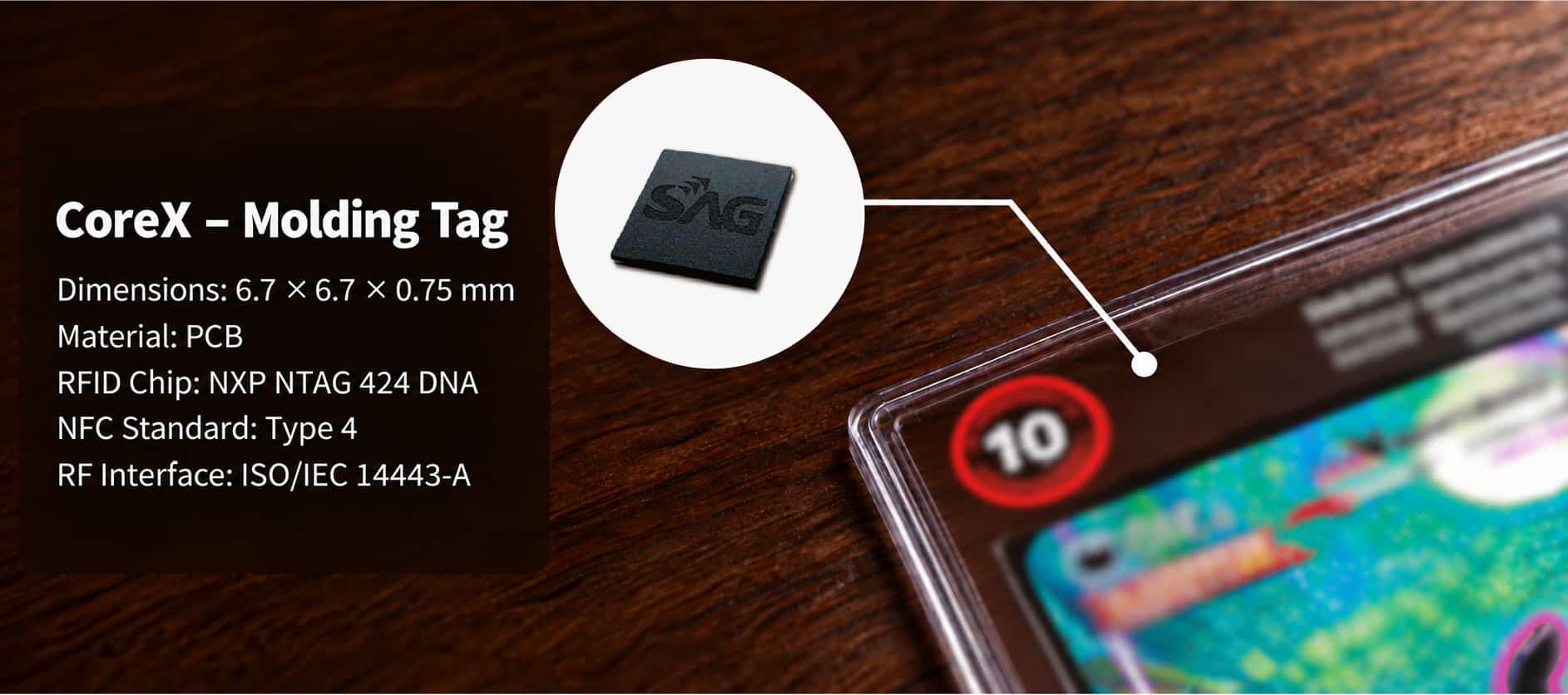
- A compact tag designed around the holder: The tag must fit inside a small area without obscuring the collectible, weakening the holder, or disrupting production. SAG's project focused on a compact, CoreX – 6.7 x 6.7 Molding Tag that could be integrated into the slab design. Mechanical requirements include tag placement, pocket dimensions, material thickness, and the tolerances of the holder assembly.
- Welding and tamper evidence work together: An embedded tag is most useful when it is difficult to transfer intact into a different holder. That makes tag placement and the holder's joining method, including ultrasonic welding where specified, part of the security design. They need to work together so that opening the holder leaves visible evidence of interference.
- A short, intentional read distance: The design targets an approximately 2 cm tap distance, leaving room to tap with a phone in a typical case while reducing unintended reads from nearby items. SAG considers the antenna, holder material, tag orientation, and differences among phones and cases when tuning the finished assembly.
4. How the Verification Works
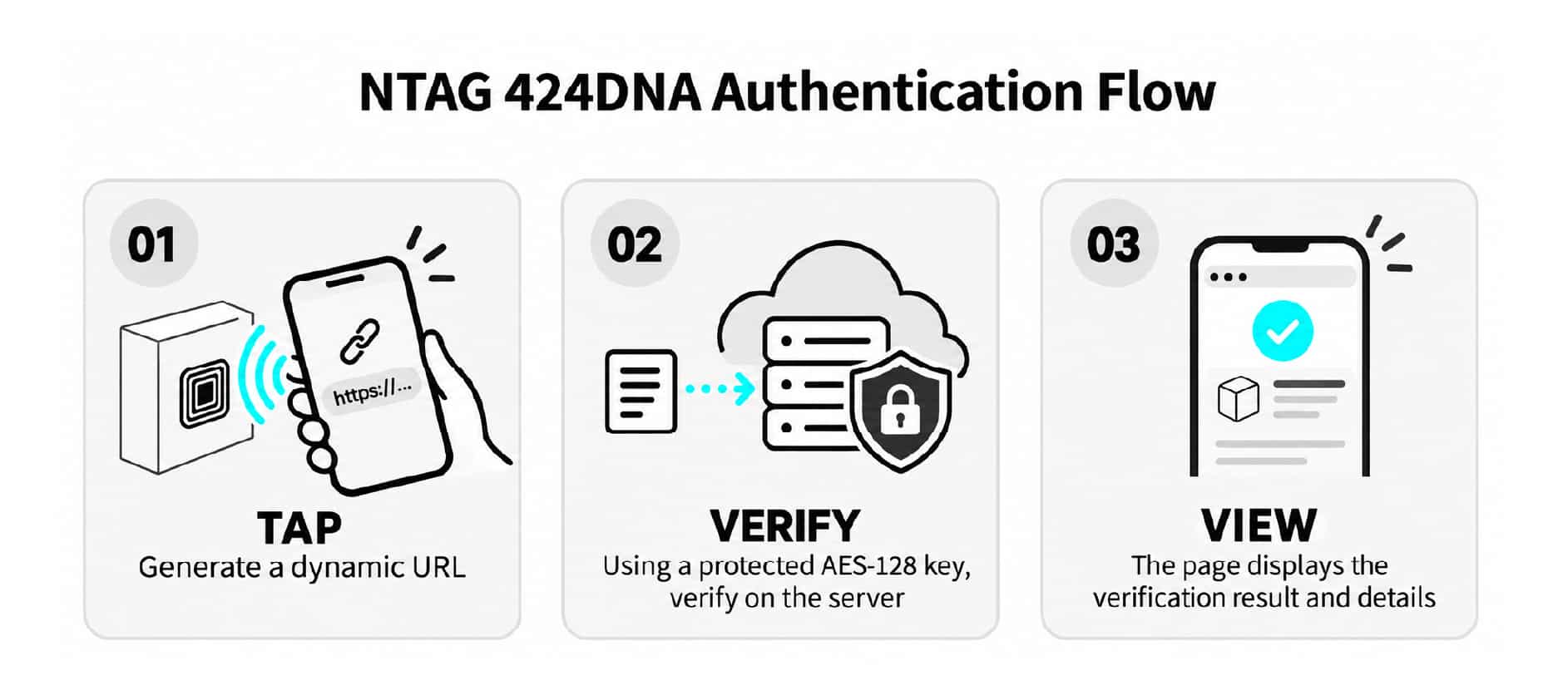
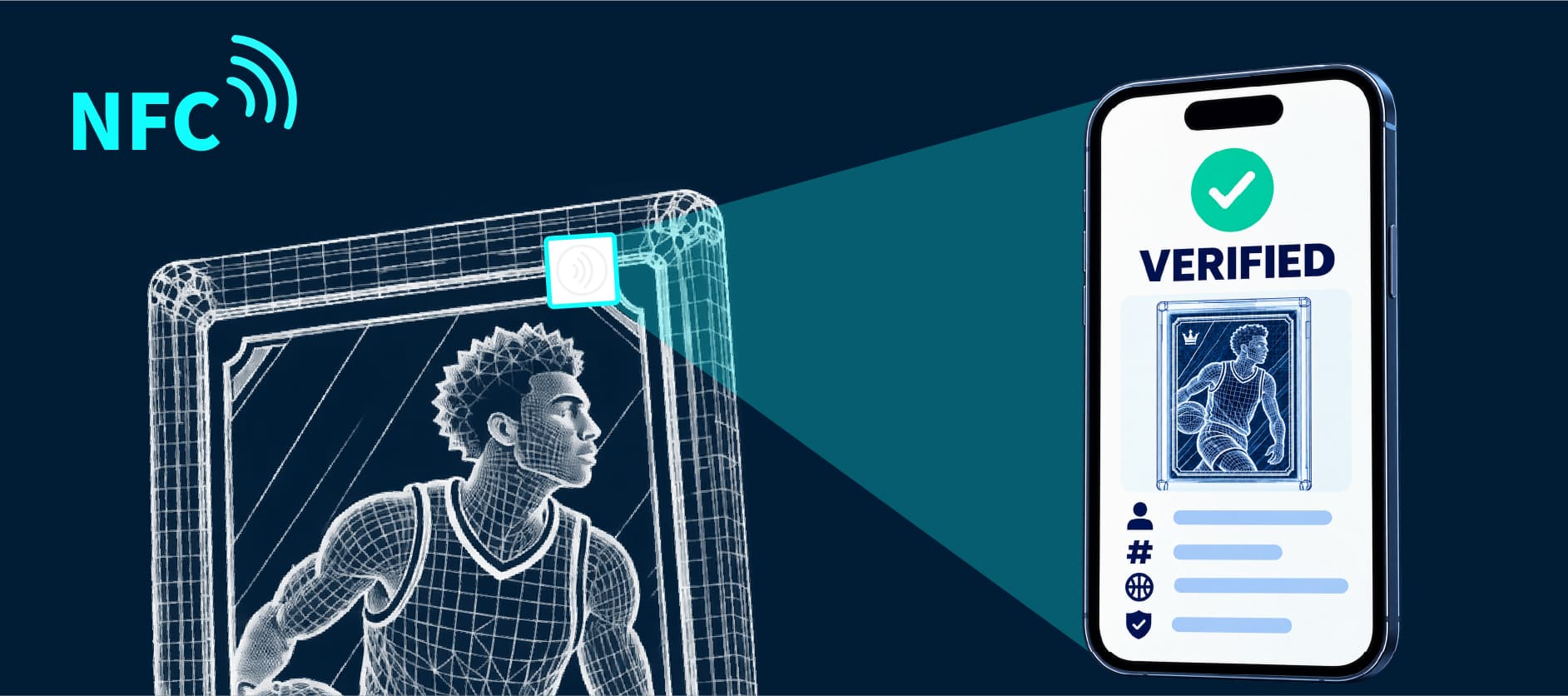
- Generate a dynamic URL: When the collector taps the slab, the chip adds new authentication data to its verification URL. The web address can stay the same; the verification data changes with each tap.
- Verify on the server: The phone opens the URL and passes that data to the backend server. Using a protected AES-128 key, the server checks the authentication code and matches the tag to its certification record.
- Show the result: The page displays the verification result and correspondingcollectible details for the buyer to compare with the item in hand.
| Standard NFC (NTAG 213) | NTAG 424 DNA | |
|---|---|---|
| Typical Use | Product information, marketing links, simple interactions | High-value authentication, brand protection, secure assets |
| Authentication | ECC signature* can verify NXP chip originality; 32-bit password controls memory access | AES-128 SUN generates authentication data for server verification on each read |
| Data on Each Tap | Fixed URL by default; UID and read counter can be added, without cryptographic protection of the tap data | When configured for SUN/SDM, each read returns a URL with changing, cryptographically authenticated data. |
| Replay Detection | Read counter available, but no authenticated per-read response | Server can detect reused reads by checking the authenticated counter |
| User Experience | Native phone tap | Native phone tap (Direct browser verification) |
5. Commercial Value of NFC Authentication
- Stronger checks at resale: A buyer can tap the holder and compare the returned record with the collectible and its grade before paying. This is particularly useful when a collectible changes hands several times. Cryptographic verification makes a copied code or simple link less convincing, while the holder design makes physical interference easier to spot.
- A simpler verification journey: Instead of entering a number manually, the collector can tap a compatible phone to reach the relevant record. A clear result page shows detailed information to compare the physical item with its digital record, including the certification number, item description, grade, and imagery if those fields are available.
- A foundation for connected services: Linking a physical holder to a verified digital record gives the authentication provider a foundation for collection management and resale services. If the platform adds ownership records or transfers, those functions can be built around the same item identity, with dedicated account and transfer controls.
- Embedding the tag protects the connection to the holder. Tag placement and tamper-evident assembly make it harder to move a genuine tag into another holder without leaving signs of interference.
- NTAG 424 DNA makes each tap verifiable. Its AES-128 SUN feature generates changing authentication data. Its built-in read counter also supports server-side detection of reused verification URLs.
- The result is easier for buyers to use. A phone tap opens the verification result and certification details, which buyers can compare with the collectible in hand.
Not Sure Where to Start?
Choosing the right RFID tag requires balancing physics, environmental conditions, and application requirements. To explore the specific formats we've discussed, check out our deep dives:
What is RFID Hard Tag?
What is RFID Label
How to choose the right RFID tags?
Ready to move forward?
Use our Product Selector to filter tags by frequency, material, and application.
Contact SAG experts for a feasibility check tailored to your specific environment.
For a refresher on the entire ecosystem, visit our guide: What is RFID
RFID tags contain a microchip with multiple memory areas:
- EPC Memory (Electronic Product Code): Used for unique identification and system integration
- User Memory: Optional space for storing additional data on the tag
- Reserved Memory: Controls access and security settings
- TID Memory: A fixed, read-only identifier assigned by the chip manufacturer
Frequently Asked Question (FAQ)
A: Metal reflects RF signals and detunes the antenna, while liquids absorb RF energy and reduce the power available to the RFID tag. Together, these effects can significantly reduce read range and communication reliability. Specialized on-metal tags and anti-liquid RFID tags are designed to overcome these challenges.
A: High temperatures cause the materials inside an RFID tag to expand at different rates, creating mechanical stress that can weaken electrical connections, deform the antenna, or degrade adhesives over repeated thermal cycles. High-temperature RFID tags use heat-resistant materials and protective construction to maintain reliable performance.
A: Standard RFID tags may experience reduced data reliability when exposed to high-dose Gamma or E-Beam sterilization. Applications requiring radiation sterilization typically use RFID tags with radiation-resistant memory technologies, such as FRAM, together with protective tag construction designed for the intended sterilization process.
A: Some liquid chemicals, particularly cleaning agents and disinfectants, can form a thin film over the antenna surface. Depending on their dielectric properties, these liquids may absorb RF energy or detune the antenna, reducing read performance even if the tag remains physically undamaged.
A: The primary tradeoff is read range. Smaller antennas naturally capture less RF energy, reducing communication distance. To compensate, miniature RFID tags optimize antenna design using technologies such as multilayer PCBs, ceramic substrates, or other specialized materials that maximize performance within a limited footprint.
Not Sure Where to Start?
If your application involves challenges such as metal surfaces, liquid interference, harsh environments, or complex workflows, a feasibility assessment is highly recommended. SAG provides application-driven RFID solutions, from tag design to system integration—ensuring reliable performance in real-world conditions.
Choosing the right RFID tag is a balance of physics, environment, and data needs. To explore the specific formats we’ve discussed, check out our deep dives:
➔ What is RFID Hard Tag?
➔ What is RFID Label?
Ready to move forward?
➔ Self-Service: Use our Product Selector to filter tags by frequency, material, and application.
➔ Expert Consultation: Contact SAG for a feasibility check tailored to your specific environment.
➔ Back to Basics: For a refresher on the entire ecosystem, visit our guide: What is RFID?