


Choose Year
Navigating Challenging Environments
Building a reliable RFID system therefore requires more than selecting the right frequency or chip. The surrounding environment plays an equally important role in determining whether an RFID tag can deliver consistent performance over its entire life. This guide explores five of the most common environmental challenges for RFID deployment—material interference, extreme temperatures, sterilization, chemical exposure, and limited installation space—and explains how purpose-built RFID tags are engineered to overcome each one.
Let’s begin with the most common hurdle: how metal and liquid interfere with radio frequency (RF) communication.

Material Interferences: Metal & Liquid
Metal is highly conductive and reflects radio waves, preventing RF signals from reaching the tag efficiently. When a standard RFID tag is attached directly onto a metal surface, the reflected energy changes the antenna's electrical characteristics (a phenomenon known as antenna detuning). As a result, the RFID chip may not receive enough power to operate, leading to reduced read range or complete communication failure. This effect is especially significant for Ultra-High Frequency (UHF), though High Frequency (HF) also experiences performance degradation against a metal surface.
The Solution: On-metal RFID tags are designed to maintain antenna performance even when installed directly on conductive surfaces. By incorporating an isolation layer or specially engineered antenna structure, these tags minimize metal-induced detuning and maintain reliable communication. They are commonly used for tracking machinery, metal containers, industrial tools, and warehouse racking.
Unlike metal, liquids do not primarily reflect radio waves, instead, they absorb RF energy. Liquids including beverages, pharmaceuticals, chemicals, and biological samples, reduce the amount of energy available for the RFID tag to operate. Depending on the frequency, liquid composition, and tag design, this absorption can significantly reduce read range or make communication unreliable. This challenge is particularly common when RFID tags are applied directly to bottles, vials, blood bags, or other liquid-filled containers.
The Solution: Anti-liquid RFID labels are engineered specifically to maintain stable performance around liquid-filled containers. By optimizing the antenna design and introducing spacing or isolation between the antenna and the container, these tags reduce the impact of RF absorption and deliver more consistent read performance throughout storage, transportation, and inventory management.

Thermal Resilience: Surviving in High Temperature
Why Does High Temperature Affect RFID Performance?
RFID tags are made from multiple materials, including the antenna, chip, adhesive, substrate, and protective housing. When exposed to high temperatures, these materials expand at different rates. Over repeated heating and cooling cycles, this thermal expansion creates mechanical stress that can weaken electrical connections, deform the antenna or damage the adhesive holding the tag in place. In severe environments, excessive heat may also soften standard plastics or adhesives, causing the tag to detach or fail prematurely.
The Solution: High temperature RFID tags are built using heat-resistant materials to maintain structural stability during repeated thermal cycles. Depending on the application, materials such as PPS or ceramics may be used to protect the RFID inlay from heat and mechanical stress. These designs allow RFID tags to remain readable throughout manufacturing processes, including paint curing, industrial baking, and other high-temperature production environments.

Environmental Hygiene: Sterilization
For example, in medical manufacturing, specialized RFID tags are attached to surgical kits or pharmaceutical containers before sterilization. As products pass through high-dose Gamma or Electron Beam (E-Beam) sterilization, RFID tags must remain readable and preserve stored data despite radiation doses of up to approximately 50 kGy. This ensures that each item can still be identified and traced throughout the sterilization process.
Why Sterilization Presents a Unique Challenge?
Let’s take a look at the severe physical and atmospheric forces applied during these decontamination routines:
High-penetration methods like Gamma rays or Electron Beams pass through packaged products to eliminate microorganisms. Unlike heat or moisture, ionizing radiation primarily affects the RFID chip itself. Depending on the radiation dose and chip design, conventional memory may experience data corruption or reduced reliability after repeated exposure.
Other sterilization methods rely on extreme physical environments rather than radiation. For example, high-pressure steam autoclaves generate intense heat (121C to 134C ) and moisture that can easily warp standard labels and allow moisture to weaken internal electrical connections. Meanwhile, gas-based methods like EtO (Ethylene Oxide) utilize alternating vacuum and pressure cycles that may place mechanical stress on poorly protected RFID tags.
Because different sterilization methods present completely different physical threats, hardware must be carefully selected to match the exact protocol being used.
The Solution: Sterilization-resistant RFID tags are designed to withstand the specific sterilization process required by the application. Depending on the environment, they may incorporate heat-resistant materials and protective encapsulation for steam sterilization, hermetically sealed housings for EtO processes, or radiation-resistant memory technologies, such as FRAM, for Gamma and E-Beam sterilization.
Because each sterilization method presents different environmental challenges, selecting the right RFID tag means matching the tag design to the sterilization protocol, not simply choosing a "sterilization-resistant" tag.
| Sterilization Method | Condition | Standard Tag | Sterilization-resistant Tag | Application |
|---|---|---|---|---|
| UV (Ultraviolet) | UV-C Light Exposure (surface only, non-penetrating) | ✓ Generally Compatible | ✓ Compatible | Laboratory equipment, work surfaces, air and water treatment |
| Steam Autoclave | Saturated steam at 121–134°C under pressure | △ Limited (most standard labels cannot withstand repeated cycles) | ✓ Compatible | Surgical instruments, reusable medical devices, laboratory glassware |
| EtO (Ethylene Oxide) | Chemical gas with vacuum/pressure cycles | △ Limited (Depends on tag construction) | ✓ Compatible | Surgical instruments, electronic devices, plastic containers, medical textiles |
| Electron Beam (E-Beam) | High-energy electron beam (typically 25–50 kGy) | ✗ Failed (Conventional memory may become unreliable) | ✓ Compatible | Medical devices, pharmaceutical packaging, cosmetics |
| Gamma Ray | High-energy gamma radiation (typically 25–50 kGy) | ✗ Failed (Conventional memory may become unreliable) | ✓ Compatible | Medical devices, pharmaceuticals, healthcare packaging |
*Sterilization-resistant tags featuring FRAM memory are typically validated for standard industrial doses up to approximately 50 kGy.
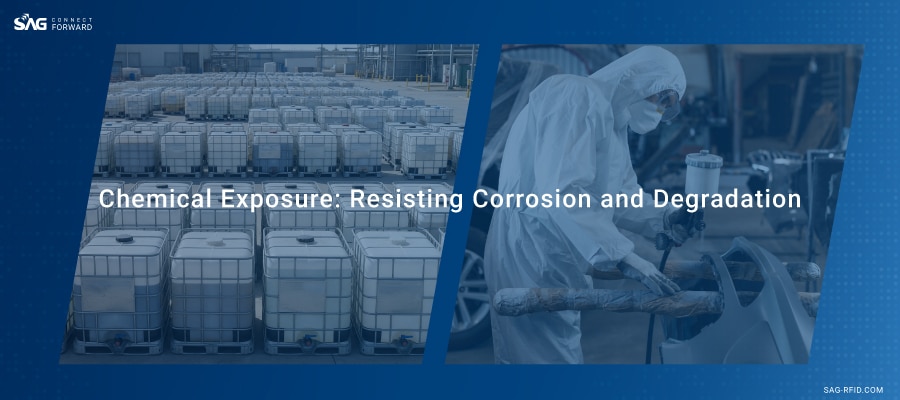
Chemical Exposure: Resisting Corrosion and Degradation
To maintain reliable traceability throughout an asset's lifecycle, RFID tags must be designed to withstand the chemical environment in which they operate.
Exposure to harsh chemicals, including disinfectants, acids, alkalis, and petroleum-based fluids, can gradually damage an RFID tag's physical structure. If these substances penetrate the tag, they may corrode the antenna or weaken the connection between the antenna and the RFID chip. Chemical exposure can also degrade adhesives and face materials, causing labels to detach from the asset over time.
Some liquid chemicals can temporarily affect RFID performance by forming a thin film over the antenna surface. Depending on their dielectric properties, these liquids may absorb or detune RF signals, reducing read reliability until the tag is cleaned or dried.
Solution: Chemical-resistant RFID tags are optimized for durable housing materials and protective encapsulation that shield the RFID chip and antenna from harsh environments. Depending on the application, engineering materials such as PPS may be used to maintain long-term durability and reliable read performance throughout repeated cleaning, sanitization, or industrial processing.

Limited Space Environments: Overcoming Size and Space Constraints
Reducing a tag's size, however, introduces new engineering challenges. Smaller antennas capture less RF energy and are often installed directly onto surfaces that further interfere with radio communication:
The read range of an RFID tag is closely related to the size of its antenna. As the available space decreases, the antenna becomes smaller and captures less energy from the reader, typically resulting in shorter read distances and reduced performance.
Small assets are often made of metal (like surgical scalpels) or contain liquids (like medical vials). Because there is little room to separate the RFID antenna from these challenging materials, the antenna can become detuned, reducing read reliability.
Solution: Miniaturized RFID tags are engineered to maximize antenna efficiency within a limited footprint. Depending on the applications, designers may use high-density antenna layouts, PCBs, ceramic substrates, or other specialized materials to maintain reliable read performance while fitting onto small or irregularly shaped assets.
Challenging environment isn't just a single problem, it is a combination of complex physical, thermal, chemical, and spatial obstacles. Whether tracking metal assets in industrial manufacturing, pharmaceutical products undergoing sterilization, or miniature surgical instruments, selecting the right RFID tag is essential for maintaining reliable identification and traceability.
Successfully overcoming these challenges requires matching your application's environmental conditions with an engineered RFID solution. Through advanced materials engineering, antenna design, and application-specific manufacturing, SAG helps organizations deploy RFID solutions that deliver reliable performance even in demanding environments.
Not Sure Where to Start?
Choosing the right RFID tag requires balancing physics, environmental conditions, and application requirements. To explore the specific formats we've discussed, check out our deep dives:
What is RFID Hard Tag?
What is RFID Label
How to choose the right RFID tags?
Ready to move forward?
Use our Product Selector to filter tags by frequency, material, and application.
Contact SAG experts for a feasibility check tailored to your specific environment.
For a refresher on the entire ecosystem, visit our guide: What is RFID
RFID tags contain a microchip with multiple memory areas:
- EPC Memory (Electronic Product Code): Used for unique identification and system integration
- User Memory: Optional space for storing additional data on the tag
- Reserved Memory: Controls access and security settings
- TID Memory: A fixed, read-only identifier assigned by the chip manufacturer
Frequently Asked Question (FAQ)
A: Metal reflects RF signals and detunes the antenna, while liquids absorb RF energy and reduce the power available to the RFID tag. Together, these effects can significantly reduce read range and communication reliability. Specialized on-metal tags and anti-liquid RFID tags are designed to overcome these challenges.
A: High temperatures cause the materials inside an RFID tag to expand at different rates, creating mechanical stress that can weaken electrical connections, deform the antenna, or degrade adhesives over repeated thermal cycles. High-temperature RFID tags use heat-resistant materials and protective construction to maintain reliable performance.
A: Standard RFID tags may experience reduced data reliability when exposed to high-dose Gamma or E-Beam sterilization. Applications requiring radiation sterilization typically use RFID tags with radiation-resistant memory technologies, such as FRAM, together with protective tag construction designed for the intended sterilization process.
A: Some liquid chemicals, particularly cleaning agents and disinfectants, can form a thin film over the antenna surface. Depending on their dielectric properties, these liquids may absorb RF energy or detune the antenna, reducing read performance even if the tag remains physically undamaged.
A: The primary tradeoff is read range. Smaller antennas naturally capture less RF energy, reducing communication distance. To compensate, miniature RFID tags optimize antenna design using technologies such as multilayer PCBs, ceramic substrates, or other specialized materials that maximize performance within a limited footprint.
Frequently Asked Question (FAQ)
A: Metal reflects RF signals and detunes the antenna, while liquids absorb RF energy and reduce the power available to the RFID tag. Together, these effects can significantly reduce read range and communication reliability. Specialized on-metal tags and anti-liquid RFID tags are designed to overcome these challenges.
A: High temperatures cause the materials inside an RFID tag to expand at different rates, creating mechanical stress that can weaken electrical connections, deform the antenna, or degrade adhesives over repeated thermal cycles. High-temperature RFID tags use heat-resistant materials and protective construction to maintain reliable performance.
A: Standard RFID tags may experience reduced data reliability when exposed to high-dose Gamma or E-Beam sterilization. Applications requiring radiation sterilization typically use RFID tags with radiation-resistant memory technologies, such as FRAM, together with protective tag construction designed for the intended sterilization process.
A: Some liquid chemicals, particularly cleaning agents and disinfectants, can form a thin film over the antenna surface. Depending on their dielectric properties, these liquids may absorb RF energy or detune the antenna, reducing read performance even if the tag remains physically undamaged.
A: The primary tradeoff is read range. Smaller antennas naturally capture less RF energy, reducing communication distance. To compensate, miniature RFID tags optimize antenna design using technologies such as multilayer PCBs, ceramic substrates, or other specialized materials that maximize performance within a limited footprint.
Not Sure Where to Start?
If your application involves challenges such as metal surfaces, liquid interference, harsh environments, or complex workflows, a feasibility assessment is highly recommended. SAG provides application-driven RFID solutions, from tag design to system integration—ensuring reliable performance in real-world conditions.
Choosing the right RFID tag is a balance of physics, environment, and data needs. To explore the specific formats we’ve discussed, check out our deep dives:
➔ What is RFID Hard Tag?
➔ What is RFID Label?
Ready to move forward?
➔ Self-Service: Use our Product Selector to filter tags by frequency, material, and application.
➔ Expert Consultation: Contact SAG for a feasibility check tailored to your specific environment.
➔ Back to Basics: For a refresher on the entire ecosystem, visit our guide: What is RFID?